
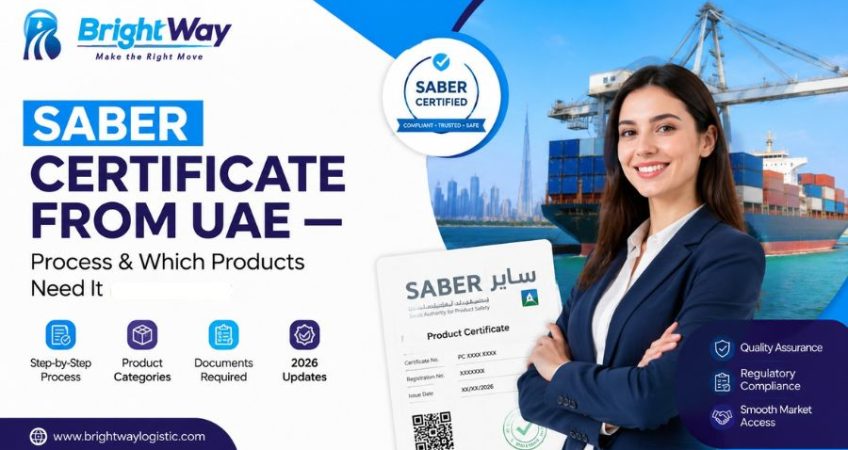
The SABER system is an online platform used for products that are being sent to Saudi Arabia. Companies exporting goods from the UAE must register their products on this system. It helps make sure the products follow Saudi rules and can enter the country without problems. Therefore, before sending their goods, businesses first get a Product Certificate (PCoC) and then a Shipment Certificate (SCoC).
If you want to export products from the UAE to Saudi Arabia, getting the SABER certificate UAE is an important step. This certificate helps make sure that products follow Saudi Arabia’s safety and quality rules. Many products need SABER approval before they can enter Saudi Arabia. That is why understanding the process and knowing which products need it can help businesses avoid delays and complete exports more easily.



- What Is the SABER Certificate?
- Why Is the SABER Certificate Important?
- Who Needs a SABER Certificate?
- Which Products Need a SABER Certificate?
- Types of SABER Certificate
- SABER Certificate Process From UAE
- 2025-2026 Compliance Updates
- How Long Does It Take
- Documents Required for SABER Certification
- Tips for Faster SABER Approval
- Why Choose Brightway Logistics?
What Is the SABER Certificate?
The SABER certificate UAE is a document needed for many products entering Saudi Arabia. It confirms that the products meet Saudi safety and quality standards. Businesses must complete the SABER registration process before shipping their goods to ensure easy customs clearance.
Why Is the SABER Certificate Important?

The SABER certificate is important for businesses that want to export products to Saudi Arabia. It helps products meet Saudi rules and makes the import process smoother and faster.
- Helps Products Enter Saudi Arabia Easily: The SABER certification Saudi Arabia process helps products clear customs with fewer delays.
- Shows That Products Are Safe: It confirms that products meet Saudi safety and quality standards before entering the market.
- Needed for Many Products: Many goods cannot be imported into Saudi Arabia without SABER approval.
- Reduces Customs Problems: The SABER certificate UAE helps avoid shipment delays, product rejection, and extra costs.
- Builds Trust with Customers: Having a SABER certificate shows that the product follows official standards and can be sold in the Saudi market.
Who Needs a SABER Certificate?

The SABER certificate is needed for businesses involved in exporting and importing products between the UAE and Saudi Arabia.
| Business Type | Why They Need a SABER Certificate |
| UAE Manufacturers | They need a SABER certificate in the UAE to show that their products meet Saudi safety and quality rules before export. |
| Exports and Traders | Businesses that export or trade products to Saudi Arabia also need to follow the SABER process. The certificate helps their products clear customs and reach customers more easily. |
| Saudi Importers | They register products on the SABER platform and obtain the needed approvals before importing goods into Saudi Arabia. |
Which Products Need a SABER Certificate?
Many products that are exported to Saudi Arabia need a SABER certificate. Products are usually divided into two groups: regulated products and non-regulated products.
1. Regulated Products
These products must meet specific Saudi safety and quality rules before they can be imported.
| Product Category | Explanation |
| Electrical and Electronic Products | Items such as home appliances, lights, cables, and electronic devices. |
| Building and Construction Materials | Products used in construction, such as cement, steel, and other building materials. |
| Chemical Products | Various chemical items that must meet safety needs before entering Saudi Arabia. |
| Automotive Parts | Vehicle parts and accessories used in cars, trucks, and other vehicles. |
| Toys and Textiles | Children’s toys, baby clothing, and different textile products. |
| Food Contact Materials | Products that come into contact with food, such as containers, packaging, and kitchen items. |
2. Non-Regulated Products
These products usually do not need detailed testing but still need registration on the SABER certificate.
| Product Type | Explanation |
| Products Requiring Self-Declaration | The importer confirms that the product follows the required rules and standards. |
| Importance of Registration | Even if a product is non-regulated, it must still be registered on SABER to help Saudi Customs process the shipment smoothly. |
Types of SABER Certificate
The SABER certificate UAE system has two main certificates that are needed to send products to Saudi Arabia. These help make sure products are safe and follow Saudi rules.
1. Product Certificate of Conformity (PCoC)
This certificate shows that a product is safe and follows Saudi standards. It is needed before exporting the product and is usually valid for one year. That is why it is an important part of the SABER certificate process.
2. Shipment Certificate of Conformity (SCoC)
This certificate is needed for every shipment. It must be taken before sending goods from the UAE to Saudi Arabia. Besides, it helps customs check and allows the goods to enter the country easily.
SABER Certificate Process From UAE

The process of getting a SABER certificate in the UAE is simple if each step is followed correctly. It helps ensure products meet Saudi rules under the SABER certificate system process system.
- Step 1: Register on the SABER Platform: The company makes an account on the SABER website and starts the registration for its products.
- Step 2: Add Product Details and HS Codes: Enter the information of each product, including HS codes, which help identify the product type correctly.
- Step 3: Check Product Classification: The system checks if the product is regulated or non-regulated under regulated products SABER KSA rules, which decides the next steps.
- Step 4: Select an Approved Certification Body: The company chooses an approved agency to check and confirm product quality and safety.
- Step 5: Obtain the Product Certificate (PCoC): This certificate proves that the product meets Saudi safety and quality standards under the SABER certificate process. Also, it is valid for one year.
- Step 6: Apply for the Shipment Certificate (SCoC): Before each shipment, a new certificate is taken so the goods can pass customs smoothly and reach Saudi Arabia without problems.
2025-2026 Compliance Updates
The SABER and SASO compliance landscape changed significantly through 2025, and exporters working off older information risk serious shipment issues.
Letters of Undertaking No Longer Accepted (Effective January 1, 2025): Previously, some exporters could rely on a Letter of Undertaking to clear customs while certification was pending. This is no longer valid — both the PCoC and SCoC must be fully issued through the SABER platform before the shipment moves, with no exceptions.
Non-Compliance Now Means Re-Export, Not Just Delay: If a shipment arrives at Saudi customs without proper SABER documentation, the consequence is no longer a processing delay — the goods are re-exported at the importer’s own cost. This shift makes upfront compliance a hard requirement rather than something correctable after arrival.
New HS Code Declaration Requirement (Effective September 15, 2025): A newly expanded list of HS codes now requires importers to submit a declaration approved by Saudi Arabia’s Ministry of Industry and Mineral Resources before an SCoC can be issued for those products. Businesses exporting electronics, machinery, or industrial goods should check whether their HS code falls under this updated list.
SASO’s Risk-Based Classification (SALEEM Program): Under the Saudi Product Safety Program (SALEEM), products aren’t simply “regulated” or “non-regulated” — SASO classifies them by risk level:
- Low-risk products are exempt from formal technical regulation but still require basic SABER registration.
- Medium-risk products must be verified by a SASO-accredited certification body under ISO/IEC 17065 standards before receiving a PCoC.
- High-risk products undergo the strictest testing and documentation review, often requiring physical inspection before certification.
Understanding which risk tier a product falls into determines exactly how much testing, documentation, and lead time the SABER process will require.
How Long Does It Take
One of the most common questions exporters have isn’t just how the SABER process works — it’s how long it takes. Here’s a realistic timeline based on standard processing windows:
PCoC Certification: 10–14 Working Days
This is the longest stage, since it involves product testing, technical document review, and approval from a SASO-accredited certification body. Delays often happen here if the certification body requests revisions, additional documentation, or a physical inspection.
SCoC Issuance: 2–3 Working Days
Once a valid PCoC is in place, requesting the Shipment Certificate for an individual consignment is much faster, provided the shipment details match the approved product registration exactly.
Saudi Customs Clearance: 3–5 Working Days
After the SCoC is verified through Saudi Arabia’s FASAH customs system, clearance typically takes a few additional working days, depending on port volume and shipment type.
Total Realistic Timeline: 3–4 Weeks
Combining all three stages, businesses should budget roughly three to four weeks from initial SABER registration to final customs clearance — longer for high-risk products or shipments requiring physical inspection.
Common Reasons SABER Applications Get Delayed or Rejected:
- Incorrect or outdated HS code — this determines which technical regulations apply, so an inaccurate code can trigger rejection or misclassification.
- Importer name mismatch — the PCoC must be issued under the name of the Saudi-based Importer of Record (IOR); mismatches between documentation and the actual importer cause clearance failures.
- Outdated technical standards — some products certified under older standards are no longer accepted under current SABER requirements and need re-certification.
Planning shipments with this realistic timeline — and avoiding these common rejection triggers — helps businesses avoid the costly re-export risk introduced under the 2025 SABER rules.
Documents Required for SABER Certification

To get a SABER certificate in the UAE, companies need to submit some important documents. These papers help check if the product is safe and meets Saudi rules under SABER guidelines Saudi Arabia system.
- Product details
- Test reports
- ISO certificates
- Product images
- Other supporting documents
Tips for Faster SABER Approval
To get a SABER certificate faster, it is important to follow a few simple steps. These help speed up the SABER approval process and avoid delays.
- Prepare Documents in Advance: Keep all papers like test reports, ISO certificates, and product details ready before starting.
- Use Right Product Information: Enter the right product names, details, and HS codes so there are no mistakes or rejections.
- Work with Approved Certification Bodies: Always choose trusted and approved agencies to check your products and make the process faster and smoother. You can also take support from logistics experts like Brightway Logistics to handle export documentation and the shipping process easily.
Why Choose Brightway Logistics?

At Brightway Logistics, we help businesses move goods from the UAE to Saudi Arabia in a simple and smooth way. We make shipping and documentation easy so our clients can focus on their business.
- Easy Shipping Support: We help you send your goods without confusion and guide you at every step of the shipping process.
- Help with Documents: We prepare and manage all important export and customs documents for you.
- Faster Customs Clearance: We work to make sure your goods clear customs quickly and without any delays.
- SABER Process Support: We help you understand and complete the SABER certificate process correctly.
- Save Time and Effort: We handle everything so you can save time and run your business easily.
Conclusion
Exporting products to Saudi Arabia becomes much easier when the SABER requirements are completed correctly. Knowing which products need approval, following the right steps, and keeping the required documents ready can help avoid unnecessary problems. As a result, businesses can send their products easily and reach the Saudi market without delays.
If you want help with this process, you can contact Brightway Logistics. Our team makes everything easy by helping with documents, registration, and customs work. We also help you step by step so your goods reach Saudi Arabia without any problems or delays. Therefore, you can reach out to us to save your time and make shipping simple and easy.