

The standard UAE customs duty on most goods is 5% of the CIF (Cost, Insurance, and Freight) value, with 5% standard VAT, which is calculated by combining the CIF value and customs duty.
To import goods, businesses need to understand that the costs of UAE import duty involved in the process include customs duty, freight insurance, VAT, and product classification, all of which determine the final amount they will pay. With this, businesses must also keep themselves up to date with the new Decree-Law updates for 2026, including the removal of self-invoicing and others, to maintain regulatory compliance.
UAE Import Duty in 2026

The standard import duty is 5% in the UAE as of 2026. This tax rate is calculated based on the total cost of the goods, including the amount paid for shipping and insurance, which is also called CIF (Cost, Insurance, and Freight). However, the actual cost depends on factors such as the type of product, HS code, country of origin, and specific application exemptions.
Here are the standard rates:
| Import Duty Category | Rate in 2026 | General Application |
| Standard Goods | 5% | Most imported goods |
| Alcohol | 50% | Applicable alcoholic products |
| Cigarettes and Tobacco | 100% | Applicable tobacco products |
| Certain Exempt Goods | 0% | Products qualifying for customs exemptions |
| Other Products | Product-specific | Depends on HS code and tariff classification |
Formula to Calculate Import Duty: Customs Duty = CIF Value × Applicable Customs Duty Rate
UAE Import Duty Rules
The UAE import duty rules that businesses must adhere to when importing goods include:
- HS Code Declarations: The importers are required to classify their goods with an applicable Harmonized System code.
- Trade License: The importer must have a relevant trade license issued by the Department of Economy and Tourism (DET) or a specific Free Zone Authority.
- Documentation: Businesses that are importing must provide the necessary documents required in the UAE customs duty process, including:
- Commercial Invoice
- Detailed Packing List
- Certificate of Origin (COO)
- Bill of Lading or Air Waybill
- Delivery Order
- Customs Declaration (Import Declaration)



How to Calculate the UAE Import Duty?

To calculate the UAE customs duty or import duty, follow the steps given below:
- Determine the CIF (Cost, Insurance, and Freight) Value, where:
- Cost is the price of the goods.
- Insurance is the cost spent on insuring the shipment during transit.
- Freight is the charges spent on the shipping and transport to the UAE port.
- Calculate UAE Customs Duty
Calculate the customs duty by using the formula:
Customs Duty = CIF Value multiplied by 5%
- Calculate Import VAT (5%)
Use this formula to calculate the UAE import VAT:
Import VAT = (CIF Value + Customs Duty) multiplied by 5% (UAE VAT rate)
What is UAE Import VAT as of 2026?
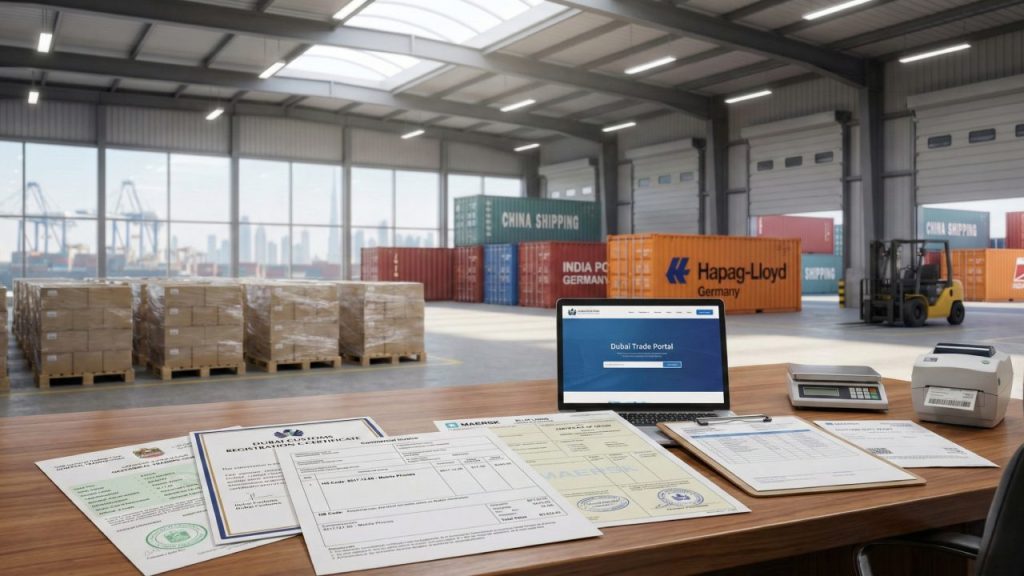
In the UAE, the standard rate of VAT is 5%, which is applicable to most of the goods imported into the country. This tax is different from customs duty, and the amount that is paid depends on the applicable VAT rules and the import value.
Moreover, it must be noted that this rate remains the same, with several compliance requirements introduced under the Federal Decree-Law No. (16) of 2025, being effective from 1st of January 2026.
UAE Import VAT Rules
Here are the UAE import VAT rules:
- Standard Rate: The standard VAT on imported goods UAE is 5%; this applies to most of the applicable goods being imported into the country.
- Registered and Non-Registered: VAT-registered businesses with a valid Tax Registration Number (TRN) can account for import VAT as input tax recovery. On the other hand, non-registered businesses pay VAT at the time of import, before customs release.
- VAT Calculation: The total import VAT is calculated based on the applicable customs value, such as relevant customs duty, freight, insurance, and other amounts under the UAE VAT rules.
- Exemptions: Certain goods imported in the UAE may be exempt or zero-rated, which depends on the applicable VAT rules.
- Compliance: To maintain compliance with the regulatory requirements, importers must ensure that they complete all the necessary documents required in the process. They should also keep themselves updated about the new regulations of the Federal Tax Authority (FTA).
How to Calculate UAE Import VAT?

Here is how you can calculate the UAE Import VAT:
- Determine the CIF Value
The formula for calculating the CIF value is:
CIF Value = Cost + Insurance + Freight
- Calculate Customs Duty
To calculate the UAE customs duty, use this formula:
Customs Duty = CIF Value multiplied by UAE customs duty rate (5%)
- Decide the VAT Taxable Base
To determine the VAT taxable base, combine the CIF value with customs duty and excise duty rate, if applicable.
Formula: Taxable Base = CIF Value + Customs Duty
- Calculate the Import VAT
Calculate the import VAT rate through:
Formula: Import VAT = Taxable Base multiplied by the UAE VAT rate of 5%
Decree-Law Updates for UAE Import Duty and VAT
Under the Federal Decree-Law No. 16 of 2025, the UAE has introduced several updates regarding tax compliance, paperwork, invoicing, and recovery.
Here are the UAE Decree-Law updates:
- Standard VAT Rates
The standard customs import duty and VAT rate remain at 5%; there are no current changes to this rate.
- Removal of Self-Invoicing
Based on the UAE VAT rule changes, businesses that are using the Reverse Charge Mechanism (RCM) are not required to issue internal tax invoices to themselves, effective from the 1st of January 2026.
- 5-Year Limitation on VAT Credits
If your business is entitled to a VAT refund or tax credit, you are given 5 years to claim it. If you do not claim it in this timeframe, you may lose the right to claim it later.
- Anti-Evasion Powers
According to the new VAT rules in UAE, before claiming input tax, businesses are required to check their transactions and suppliers. If it is caught committing fraud, or if there were clear signs that it should have noticed, in this case, the FTA (Federal Tax Authority) can deny the company’s input VAT deduction.
Conclusion
Before importing goods in the UAE, businesses must consider understanding the new updates regarding the UAE customs duty and VAT. As the standard 5% rate for customs duty and VAT remains unchanged, the UAE has introduced the new Decree-Law amendments and FTA requirements that cannot be ignored when importing goods in the country.
If you are a business that needs professional guidance regarding importing goods in the UAE, connect with Brightway Logistics Services LLC. As a transport and logistics company in the UAE, we help businesses with import duty, VAT, customs clearance, and documentation. Our services also include freight services and IOR and EOR solutions to make international trade compliance easy and simple. Thus, feel free to reach out to us today to get your personalized solutions.
Also Read:
How to Ship from China to Dubai — Cost, Time & Process 2026
Hazardous goods shipping from UAE: IMDG rules, docs & packing — with Brightway Logistics.
SABER Certificate for Saudi Arabia: What Importers Need to Know in 2026
Land Freight Services In UAE
Best Logistics and Freight Forwarding Companies in the UAE (2026 Guide)