
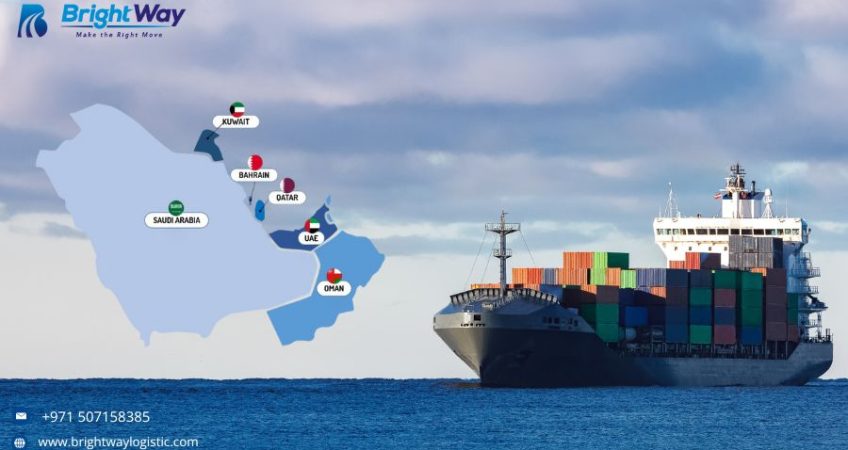
The main logistics entry point to the markets of the Gulf Cooperation Council (GCC), which include Saudi Arabia, Bahrain, Qatar, Kuwait, and Oman, is the United Arab Emirates (UAE). The most popular and economical way to move big commercial volumes is by sea freight shipping UAE to GCC, which makes use of the country’s top-notch ports.
An easy-to-understand, step-by-step guide to shipping from the United Arab Emirates to the Gulf Cooperation Council. Understanding the intricacies of regional logistics requires collaboration with a seasoned freight forwarding partner, such as Bright Way Logistic Services LLC.
Initial Planning and Preparation

Clear planning and cargo preparation are the cornerstones of a successful UAE to GCC shipping guide.
Specifying Your Shipment
Prior to contacting a logistics company, ascertain the following crucial information about your cargo –
- Cargo Type – What are you transporting, such as industrial raw materials, machinery, or consumer goods? Packaging and documentation are determined by this.
- Dimensions and Weight – The best shipping method is determined by dimensions and weight.
Mode of Shipping (FCL vs. LCL) –
- Full Container Load (FCL) – A 20-foot or 40-foot container is reserved and used in its entirety. For large quantities, this is quicker and typically less expensive per unit.
- Less than Container Load (LCL) – Other shippers share container space with your goods. This offers cost savings for smaller shipments (a few pallets, for example), but it may result in longer transit times because of consolidation and deconsolidation.
Incoterms – Specify the obligations for risk and cost transfer between the buyer/importer and you (the seller/exporter) (e.g., FOB, CIF, DAP).
Choosing the Right Port and Service

The UAE boasts many top-class ports that promote sea freight services UAE to the GCC –
| UAE Origin Port | GCC Destination Port | Relevance |
|---|---|---|
| Jebel Ali Port (Dubai) | Dammam (Saudi Arabia), Hamad Port (Qatar) | Largest hub, offering the most frequent and diverse services. Ideal for FCL and LCL. |
| Khalifa Port (Abu Dhabi) | Jeddah Islamic Port (Saudi Arabia), Sohar (Oman) | Highly automated, connecting to major industrial zones. |
| Port Khalid (Sharjah) | Kuwait City, Bahrain | Often utilized for more localized or specific feeder services across the Gulf. |
Your forwarder, such as Bright Way Logistic Services LLC, will advise on the most suitable port and shipping line depending on price and transit time.
Documentation – The Key to Customs Clearance
Documentation is the single most crucial aspect in bypassing uncertainties and fines when driving sea freight shipping UAE to GCC. All documents must be precise and uniform.
- Essential Export Documents (UAE Side)
- Commercial Invoice – The goods’ value, quantity, and description should be specified, and the ultimate buyer identified.
- Packing List – Lists the contents of every package or container along with gross and net weights and dimensions.
- Bill of Lading (B/L) – The legal agreement between the shipper and the shipping company. It serves as a receipt for the cargo and a document of title.
- Certificate of Origin (CoO) – Indicates the location of the production of the goods. This is very important for accessing any special trade agreements between the UAE and the destination GCC country. Note – For goods made in the UAE, this can be a determinant for tax exemption upon importation into another GCC country (Makasa/ATCD process).
- Export Declaration – Presented to UAE Customs (usually through systems like Dubai Trade/Mirsal 2) to formally notify that the goods are leaving the UAE.
- Destination-Specific Compliance (GCC Side)
Every GCC nation has its own import regulations. Your forwarder is responsible for making sure the paperwork satisfies the requirements of the destination nation, particularly with regard to –
- HS Codes – Since the Harmonized System (HS) code determines the customs duty imposed at the destination, it must be accurate.
- Language – Documentation may need to be bilingual or in Arabic, particularly the commercial invoice and labels.
- Restricted Goods – Certain products, such as food, medical supplies, chemicals, or particular electronics, need special permits.
Execution – From Warehouse to Vessel

This phase is mainly driven by your freight forwarder, who coordinates all logistical activities.
- Export Haulage (Pickup) – The forwarder takes care of all the arrangements for the pickup of your goods from your warehouse or premises (or Free Zone location). In the case of FCL, an empty container is directly brought to your place for loading. In the case of LCL, the goods are moved to a Container Freight Station (CFS) to be amalgamated with other shipments.
- UAE Customs Clearance (Export) – The forwarding agent presents the Export Declaration together with all the documents (B/L, Invoice, CoO) required by UAE Customs. The moment the approval is granted, a certificate of completion for export customs is issued, giving clearance to the goods to exit the UAE.
- Cargo Handling and Loading – The goods or the container are transferred to the port terminal designated for them (for instance, Jebel Ali). The shipping company puts the container on the ship in accordance with the scheduled booking.
- Ocean Transit and Tracking – The ship goes to the port of destination in the Gulf Cooperation Council (GCC). The transit times within the Gulf are usually short (generally 2–7 days) but can be altered by port congestion or vessel schedules. Forwarders of good reputation offer the service of tracking in real-time, so you are always informed about the position of your sea freight shipping from UAE to GCC.
- Import Customs Clearance (Destination) – The process mentioned below takes place when the vessel reaches the designated place (e.g., Dammam Port, Saudi Arabia, or Hamad Port, Qatar) –
- Submission of Documents – The importer or the customs broker appointed by him presents the import declaration, original B/L, Commercial Invoice, and CoO to the customs authority of the destination country (e.g., Saudi Customs through FASAH).
- Duty Payment – Customs duties and Value Added Tax (VAT) are calculated and paid based on the cargo’s CIF value (Cost, Insurance, and Freight). The GCC countries generally maintain a common external customs tariff but there might be slight variations in rates and procedures.
- Inspection – Customs officials might choose to do a physical inspection of the selected container.
- Clearance – Upon duty payment and clearance of goods, a release order is issued.
- Destination Haulage and Delivery – The container or cargo that has been cleared is picked up from the port terminal. The last delivery is done by truck to the buyer’s warehouse or facility, thus concluding the shipping from UAE to GCC procedure.
Why Partner with an Expert? (Bright Way Logistic Services LLC)

One cannot underestimate the role of an expert freight forwarder in dealing with the challenges of sea freight shipping UAE to GCC countries, particularly the necessity to customize the approach with respect to the diverse customs, regulations, and documentation systems in Saudi Arabia, Qatar, and other GCC states.
The company Bright Way Logistic Services LLC is a leading example of such an expert freight forwarder, and its services include –
- Regional Expertise – Master knowledge of port processes and customs systems (for instance, FASAH in Saudi Arabia, Trakhees in Dubai).
- Network Strength – Amicable ties with the biggest shipping lines and local customs brokers in all GCC countries.
- End-to-End Visibility – Direct control of the entire chain, from your UAE warehouse to the final delivery in the destination country.
Going with a professional logistics partner not only lessens the delays but also lowers the chances of being slapped with non-compliance fines and, at the same time, guarantees that your cargo moves without any issue through the Gulf.
Frequently Asked Questions
What documents are required to be done for sea freight from UAE to GCC?
Common documents include the commercial invoice, packing list, bill of lading, certificate of origin, and customs clearance documents as per GCC regulations.
How long does sea freight shipping take from UAE to GCC?
The usual time of transit ranges from 3 to 10 days, depending on a destination port, route of shipping, and terms of customs clearance.
What is the difference between FCL and LCL in sea freight shipping?
FCL means a container is reserved for one shipment that is usually suited for large volumes. LCL uses one container and is utilized when smaller shipments need shipping.
Which UAE ports are commonly used for GCC sea freight?
The most common UAE ports of call for GCC shipping are the Jebel Ali Port of Dubai, Khalifa Port of Abu Dhabi, and Sharjah's Port Khalid.